This rRNA depletion method uses Ribominus Kit by ambion. This protocol is a modified version of the protocol provided with the kit and is good for rRNA depletion of up to 5µg of total RNA in one reaction.
Advantages of this protocol:
- Reduced cost of reagent
- Simplified steps.
- Less hands-on time
How it works:
The “active ingredients” in this kit are the 5’biotin-labeled Locked Nucleic Acid (LNA) probes which have sequences complementary to the eukaryotic ribosomal RNAs. The probes are first hybridized with the rRNAs in the total RNA, then the streptavidin-labeled magnetic beads “pulls down” all the rRNAs by binding to the biotin-labeled probes, leaving only non-rRNA RNA floating free in the supernatant.
Material/Reagents:
– RiboMinus™ Eukaryote Kit for RNA-Seq
Catalog. no. A10837-08
– 3M sodium acetate
– Isopropyl alcohol
– 80% ethanol.
– Glycoblue coprecipitant (or glycogen )
– Magnetic stand for 1.5ml eppendorf tubes (optional)
– Low-binding, nuclease free 1.5ml tubes.
*Experiments should be conducted in a Nuclease-Free environment.
Probe Hybridization:
10µl total RNA (add nuclease free water if volume is less than 10µl)
4µl Probe
150µl Hybridization buffer
164µl total
Mix by gently flicking the tubes, spin down briefly with a mini centrifuge.
On a thermal cycler, set up the following program and place the reaction on the cycler:
75˚C 5min, 37˚C 30min, 37˚C forever
While the hybridization reaction is incubating, go ahead and prepare the magnetic beads.
Preparing RiboMinus beads:
- Set up a 37˚C heat block or water bath for 1.5ml tubes
- Fully resuspend the beads by vortexing
- Take out 200µl beads into a 1.5ml tube, place on to the magnet stand, let stand for 2mins for until the supernatant is clear.
- Take out and discard the supernatant. Be careful not to disturb the beads.
- Wash the beads by fully resuspend with nuclease-free water, place back on magnetic stand, and discard the supernatant.
- Repeat step 5 once.
- Wash with 250µl of hybridization buffer. Discard the supernatant
- Resuspend beads with 100µl hybridization buffer, keep at 37˚C until ready to use.
Ribosomal RNA removal
- Once the hybridization steps have moved to the 37˚C forever hold, and the beads preparation is finished, quickly add hybridized sample to the 1.5ml tube containing prepared magnetic beads, mix well by pipetting. Try to avoid cooling of the samples and the beads from 37˚C.
- Incubate at 37˚C for 15-20mins, mix the beads every 7-9mins by gently flicking the tubes.
- Briefly, spin down the tubes to get all the liquid to the bottom of the tube. Place the tube on a magnetic stand, let stand for 5mins for until the supernatant is clear.
- Collect the supernatant. This contains the rRNA depleted RNA. Pipette up slowly so you don’t disturb the beads. It’s ok to leave some liquid behind so you don’t accidentally get any beads.
- Gently, resuspend beads in 25µl Hybridization buffer, place tube on magnetic stand again until supernatant is clear. Collect supernatant again.
Purify depleted RNA using precipitation method:
1.
279µl Supernatant collected
30µl 3M sodium Acetate
2µl Glycoblue (or glycogen)
320µl Isopropyl alcohol
630µl total
- Mix well by inverting or vortexing. Incubate -80˚C > 30min.
- Spin at 15,000rpm, 4˚C for 1hr
- The RNA should form a visible pellet on the bottom of tube. If glycoblue is used, the pellet is blue with lighter outer edges this should be easy to spot. If regular glycogen is used, the pellet is a translucent white, which could be hard to see.
- Carefully pour out supernatant without disturbing the pellet. It’s ok if some liquid is left.
- To wash pellet, add 800µl ice cold 80% ethanol. Gently invert the tubes 4-5 times, spin 15,000rpm, 4˚C for 8mins.
- Make sure the pellet is still on the bottom of the tube. Pour out supernatant and wash with 80% ethanol again.
- Make sure the pellet is still on the bottom of the tube. Pour out supernatant, keep the tube upside down and cap open, dab gently onto a kim-wipe to get rid of excess ethanol. Air-dry the pellet for 5min or until all visible ethanol have evaporated.
- Resuspend the pellet by adding 20µl nuclease-free water. Do not pipette up and down or the pellet might get stuck in the pipette tip. Just make sure the pellet is fully emerged in water, allow it to incubate for 15-20min on ice to fully dissolve the pellet.
- Briefly vortex the sample, spin down to collect the liquid to the bottom of the tube.
- Finally, quantify the RNA using method of your choice. We like to use Qubit RNA HS kit.
- Add RNase inhibitor to the RNA, it is now ready to be used or can be stored in -80˚C.
Notes:
- Agilent Bioanalyzer result of RNA before and after rRNA removal


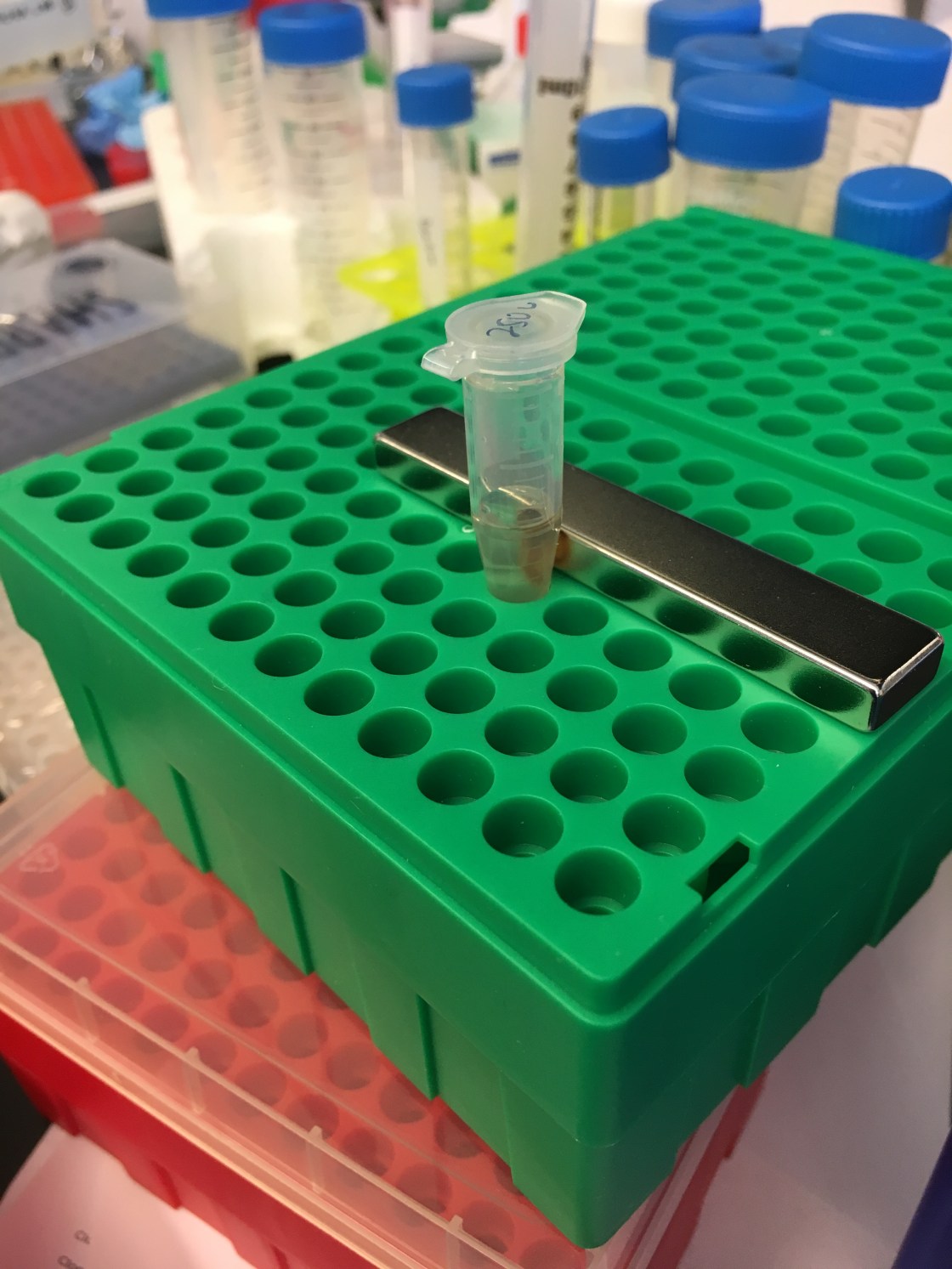
- Although this kit uses magnetic beads, it is not necessary to buy a magnetic stand to complete this experiment, especially when the mark-up price for the magnetic stands sold by the kit’s companies are ridiculously high. One can buy a strong magnet from Amazon for few dollars, and tape it to a pipette tip rack to make a “ghetto” magnetic stand, which gets the job done.
 RNA-seq: Protocols that Work!